
The Gunman Project (Gunman) is centred on a high-grade zinc concentration near the Bald Mountain gold mine and about a 90 minute drive south of Elko in White Pine County of eastern Nevada. The mineralization on the eastern apron of the Diamond Range is deeply weathered to form high-grade zinc oxides. Drilling by Pasinex Resources Limited (“Pasinex”) in 2018 resulted in a significant new discovery of zinc sulphides beneath the zinc oxides. This provokes a radical rethink of Gunman’s exploration potential. The known mineralized occurrences run north-south and Pasinex has now staked ground extending five kilometres to the north and to the south of the initial ground holding to provide room for a major discovery.
Pasinex holds a 51% interest in the Gunman Project, a zinc and gold exploration property located in White Pine County, Nevada.
Pasinex earned that interest in 2023 by satisfying the first stage of its option agreement with Century Lithium Corp. (formerly Cypress Development Corp.) and Caliber Minerals Inc. The consideration comprised US$425,000 in cash payments, the issuance of 4.6 million Pasinex common shares and US$1.85 million in qualifying exploration expenditures.
The original agreement gave Pasinex the opportunity to earn a further 29%, which would have taken its ownership to 80%. That option period has since expired and Pasinex retains its 51% interest. Pasinex maintains a positive working relationship with Century and believes there may be an opportunity to build on the original earn-in structure through further investment in and advancement of the project, subject to agreement between the parties.
In 1990, Western Mining (WMC) was exploring for gold guided by outcrops of Jasperoids in the basin west of Bald Mountain vectoring westward across a range front fault onto the eastern apron of the Diamond Range. WMC “stumbled” over what became the RH Main Zone high-grade zinc oxide discovery. Zinc was of little interest to a gold explorer. Cypress Development Corp. (“Cypress”) explored Gunman intermittently between 2000 and 2014. A total of 114 reverse circulation drill-holes and 17 diamond drill holes delineated a limited part of a trend including the RH Main, RH North and RH South prospects. Pasinex optioned this high-grade zinc-oxide property from Cypress in 2017 because of its similarities to its Pinargozu high-grade zinc carbonate replacement deposit (CRD) in Türkiye.
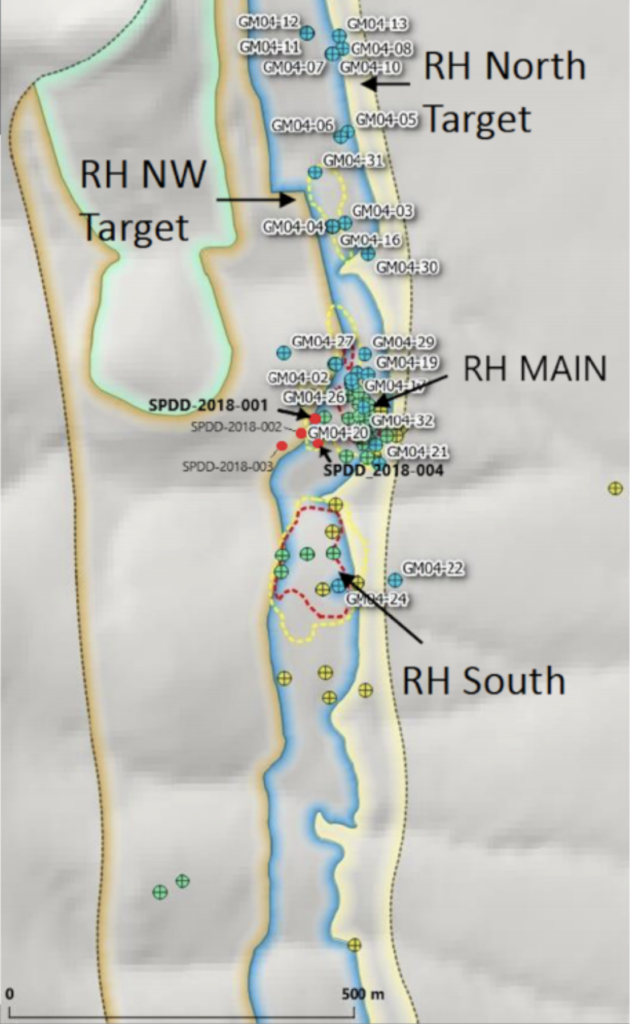
At Gunman and specifically in RH Main Zone reverse circulation drilling programs totalling 12,250 metres intersected zinc grades between 5% to 33% and also silver between 15g/t to 465g/t and some minor lead over substantial widths. The deposit has central zones of massive, strongly oxidized mineralization and halos of partial replacement and veining. The mineralization is within 125 metres of the surface.
Previous explorers drilled the core of RH Main Zone by reverse circulation drilling. Such drilling identifies mineralization but provides very little else in terms of useful structural information which give clues the orientation of feeder structures.
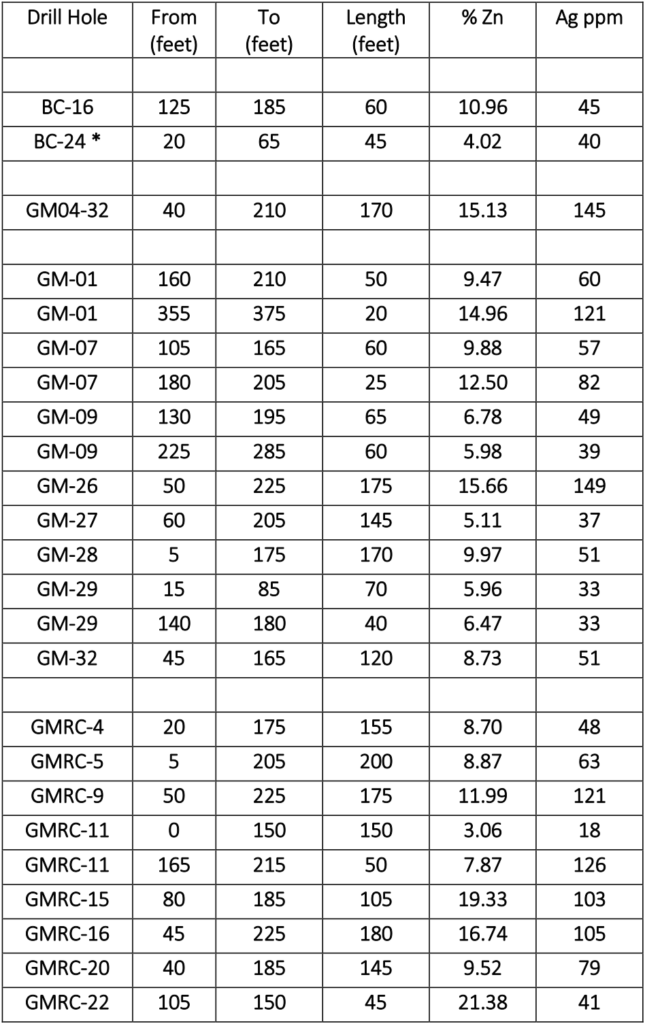
Figure 1
**Apart from BC-24, in the RH South zone, all intersections are from RH main zone.
Note: True widths of the drill hole intersections reported in the Figure 1 cannot be determined from the information available.
In 2018 Pasinex drilled four inclined and oriented diamond drill-holes to try and better understand the geology and the controls on the mineralization. During Pasinex’s limited surgical drilling campaign at RH Main, diamond drill hole SRDD-2018-001 cut 144 feet (43.9 metres) averaging 14.2% of oxide zinc from 142 feet (43.3 metres) – including 45 feet (13.7 metres) averaging 26.1% zinc and 242 g/t silver (5.6 ozs) from 160 feet (48.8 metres). Pasinex is now assessing potential similarities to the relatively nearby Eureka CRD District (2Mt of 1.65M oz Au, 39M oz Ag and 625M lbs Pb)1. Eureka ores were thoroughly oxidized so most of the zinc was flushed out.
Read the original press release here: Pasinex Resources Intersects Black-Shale Hosted Zinc Sulphides Beneath High-Grade Zinc Oxides at its High-Grade Zinc Project in Nevada
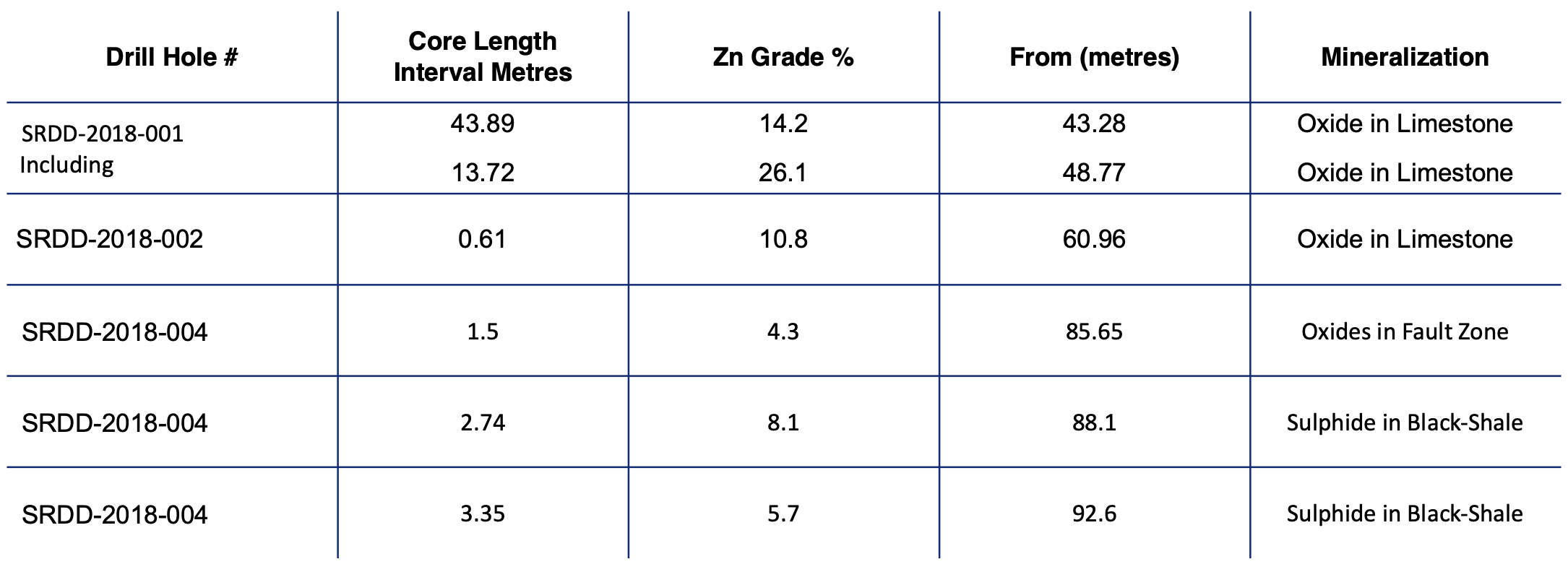
The last drill hole in Pasinex’s drilling campaign, SRDD-2018-004 made a surprising discovery – the intersection of the black-shale-hosted zinc-sulphide 50 metres south and down-plunge of drill hole SRDD-2018-001. This is a highly unusual rock type to be mineralized in a CRD setting. The intersection was nine feet (2.74 metres) averaging 8.1% zinc from 289 feet (88.1 metres) and 11 feet (3.35 metres) averaging 5.7% zinc from 304 feet (92.6 metres).
Read the press release here: Pasinex verifies high grade zinc oxides: 43.9 metres @ 14.2% zinc including 13.7 metres @ 26.1% zinc and 5.6 ounces of silver.
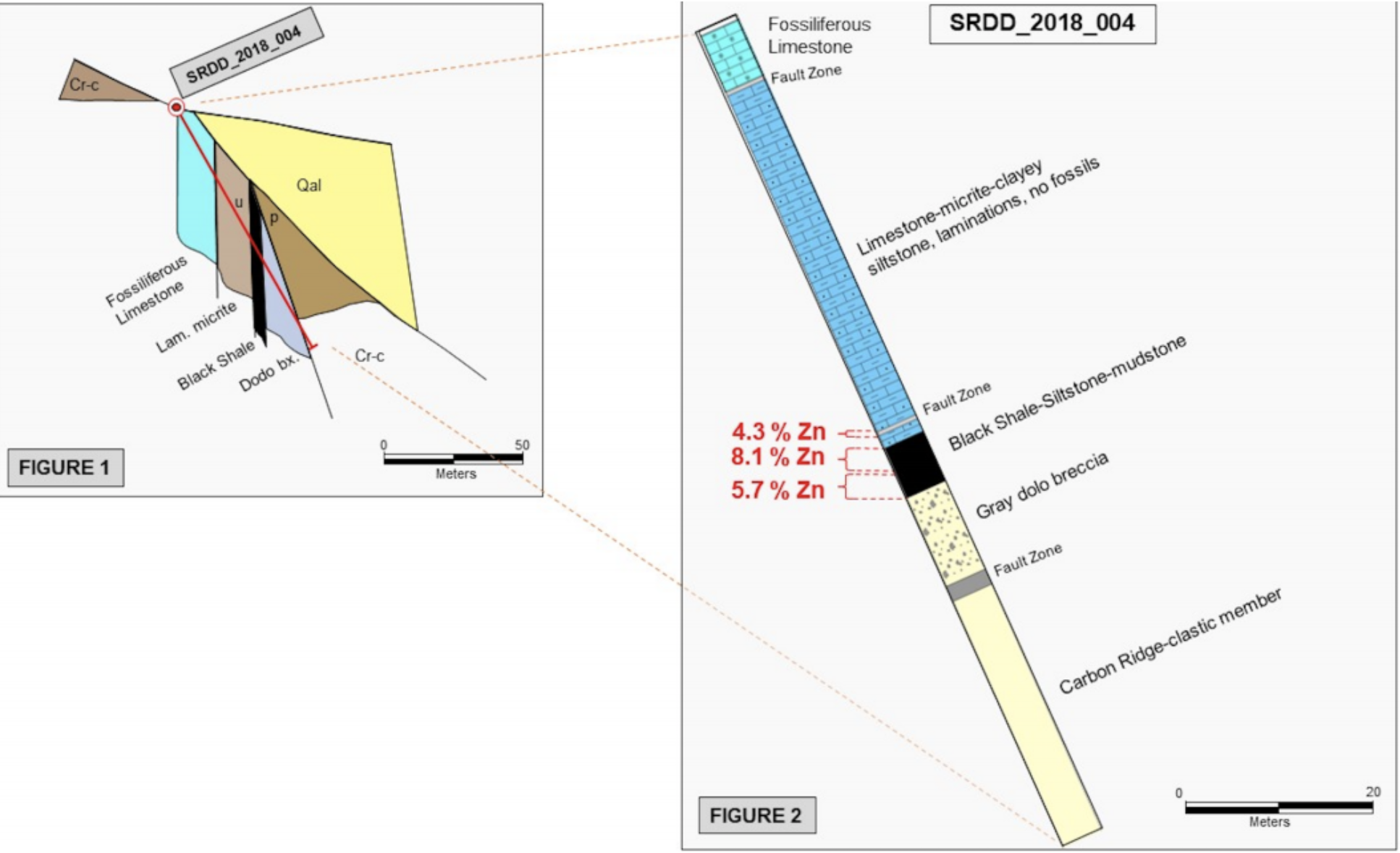
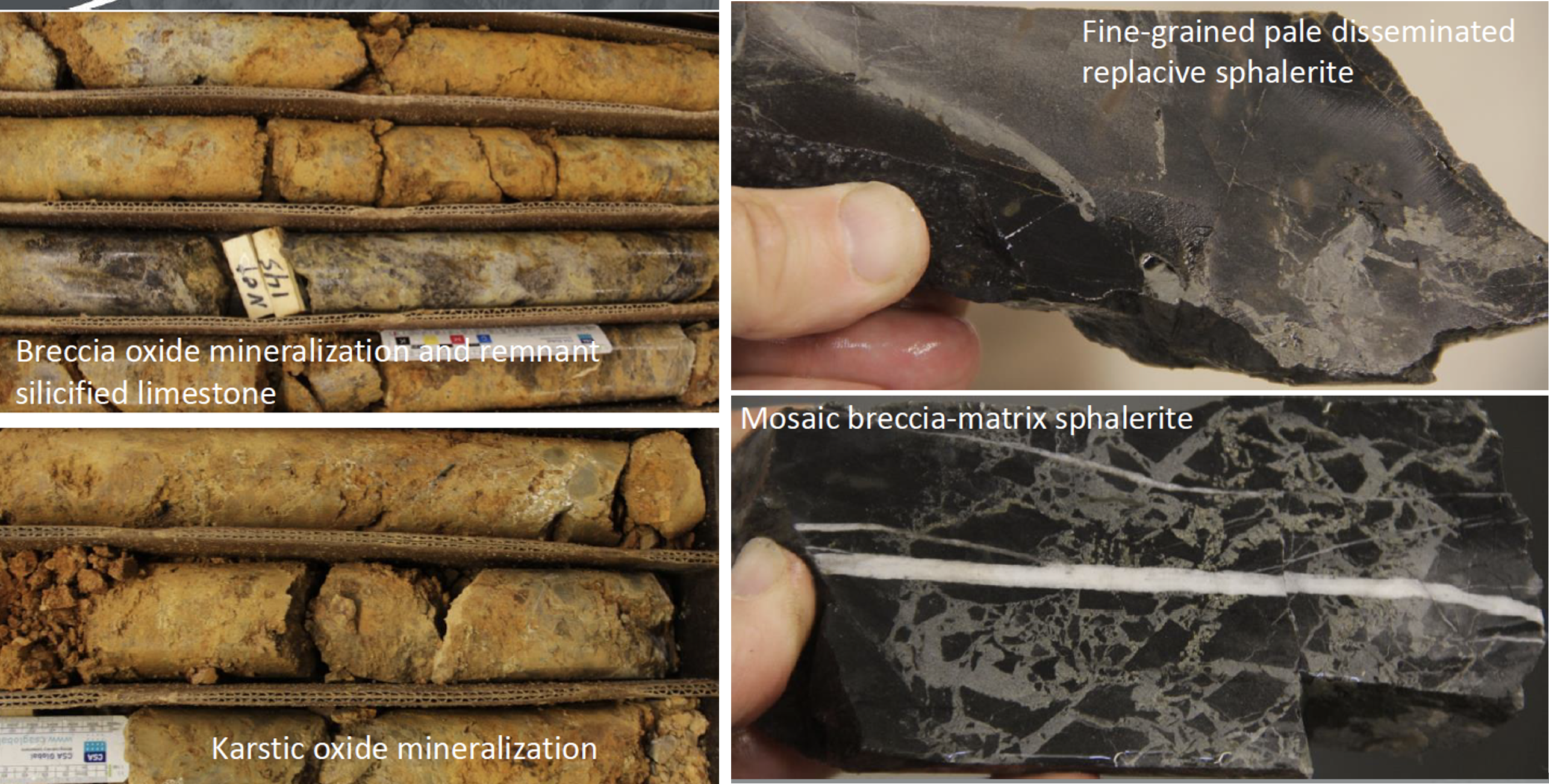
This exploration project has now not one but two distinct and compelling exploration targets. The upper limestone-hosted high-grade zinc oxide mineralization may be the weathered top of a much deeper wall-rock Carbonate Replacement Deposit (CRD) while the shale-hosted zinc sulphide mineralization may represent the distal fringes of a very different deposit type – a shale-hosted massive sulphide deposit (SHMS). Alternatively these two deposit types may be related and not mutually exclusive.
On the eastern flank of the Diamond Range steeply dipping Ely Limestone of Pennsylvania age hosts the high grade zinc oxide mineralization. The Ely Limestone lies unconformably below the gently dipping Carbon Ridge Formation of Permian age. The Ely Limestone was folded during the Antler Orogeny prior to deposition of the overlying Carbon Ridge. The last hole in the recent drilling program intersected creamy low-iron sphalerite (zinc sulphide) at the base of the Ely Limestone. The black shale could be part of the Ely Formation. Another possibility is that it represents an attenuation of the Chainman Shale Formation of older Mississippian age. The contact between the Ely Limestone and the Chainman Shale Formation in this part of Nevada is conformable. The Chainman is extensively mineralized in Nevada and the main host to the Carlin Trend gold deposits. The late Professor Sam Carey, the renowned iconoclast and revolutionary geologist said “we must disbelieve if we can, challenge the model, never sit back and believe what you read or are told to believe and question everything rigorously and then if you do accept the model, you have verified it for yourself and you have made it your own”. That is how major discoveries are made.
The exploration potential for possibly two quite distinct deposit types has now emerged. On the other hand the oxide zinc mineralization in the limestones maybe be related to the deeper zinc sulphide mineralization in the black shales.
The CRD target: The Taylor Deposit sold (remaining 83%) by Arizona Mining to South32 for US$1.3 billion is an example of a major CRD deposit in neighbouring Arizona. Another good example of the potential prize is the historic Leadville Mine in Colorado which exploited a major CRD Deposit. Examples of major SHMS deposits further north in Canada would be Red Dog in Alaska and Sullivan in British Columbia and bringing us up to the present day would be Fireweed Zinc’s Macmillan Pass Project in the Yukon.
Pasinex asked world-renowned CRD exploration geologist Peter Megaw to visit Gunman and examine the drill-core. Peter commented: “I would note from the start that the evidence to date is that the CRD style mineralization present is clearly of economic size and interest and that chasing it is fairly straightforward. The purported SHMS mineralization known may be of significant volume, but some pretty strong evidence will need to be mustered that it is actually a different genesis from the fairly typical CRD mineralization. Gunman has the chemical earmarks of CRD mineralization: in fact it looks like it could be a series of stacked bedding replacements and oxide “smearing” between, similar to the relatively nearby Eureka District (2Mt of 1.65M oz Au, 39M oz Ag and 625M lbs Pb); Eureka ores were thoroughly oxidized so most of the zinc was flushed out”.
Bill Tafuri a highly experienced Nevada geologist, based in Park City, Utah, mapped the mineralized zones at Gunman in detail and commented: “the Gunman zinc-silver prospect represents a significant discovery and I expect could be expanded in size due to the extent of the presently known mineralization being open in several directions plus the excellent potential to make additional discoveries in the expanded claim-block”.
Dr Neal Reynolds of CSA Global is a recognized international expert on zinc mineral systems, including SHMS and lower temperature Irish-style and MVT deposits. Pasinex asked Dr Reynolds to consult on Gunman and he visited the site and logged the drill-core from the recent drilling program. Dr Reynolds commented: “the important point is that it is a significant system and that we can better use available historical data to understand it and design an effective test that is inclusive of both CRD and SHMS models”.
Pasinex advanced the geological understanding of the Gunman Project through a comprehensive exploration program undertaken with the geological services of Ronacher-McKenzie. The program included:
These results were integrated with the Company’s existing geological and geochemical information and used to develop a planned 3,000-metre, 17-hole drilling program targeting three principal areas:
A drilling contractor was mobilized to the property in November 2023. Drilling was discontinued in February 2024 following operational and technical issues with the program, and management determined that the results were not sufficiently reliable or relevant to the Company’s exploration objectives. A further exploration and drilling program, budgeted at approximately US$500,000, was subsequently deferred as Pasinex prioritized its financial and operational resources toward the restart and advancement of the Pınargözü Mine and the Sarıkaya Project in Türkiye.
Pasinex continues to maintain its 51% interest in the Gunman Project and believes the property warrants further exploration. The extensive geophysical, geochemical and geological work completed to date provides a strong technical foundation for future drilling designed to test the priority targets identified across the property.
The Company continues to evaluate opportunities to advance Gunman through additional exploration, financing and potential strategic arrangements, and has maintained dialogue with parties active in the surrounding area. Bronco Creek Exploration, which holds claims adjacent to the Gunman Project, has previously approached Pasinex regarding potential coordinated exploration activities.
Further exploration and drilling at Gunman will be considered in the context of available financing, potential strategic partnerships and the Company’s broader exploration and development priorities.
1Graton Sales volume 1968 – historic production of oxides. A larger tonnage of sulfide ore remains unmined and there is a possible genetic link to surrounding multi million ounce gold deposits